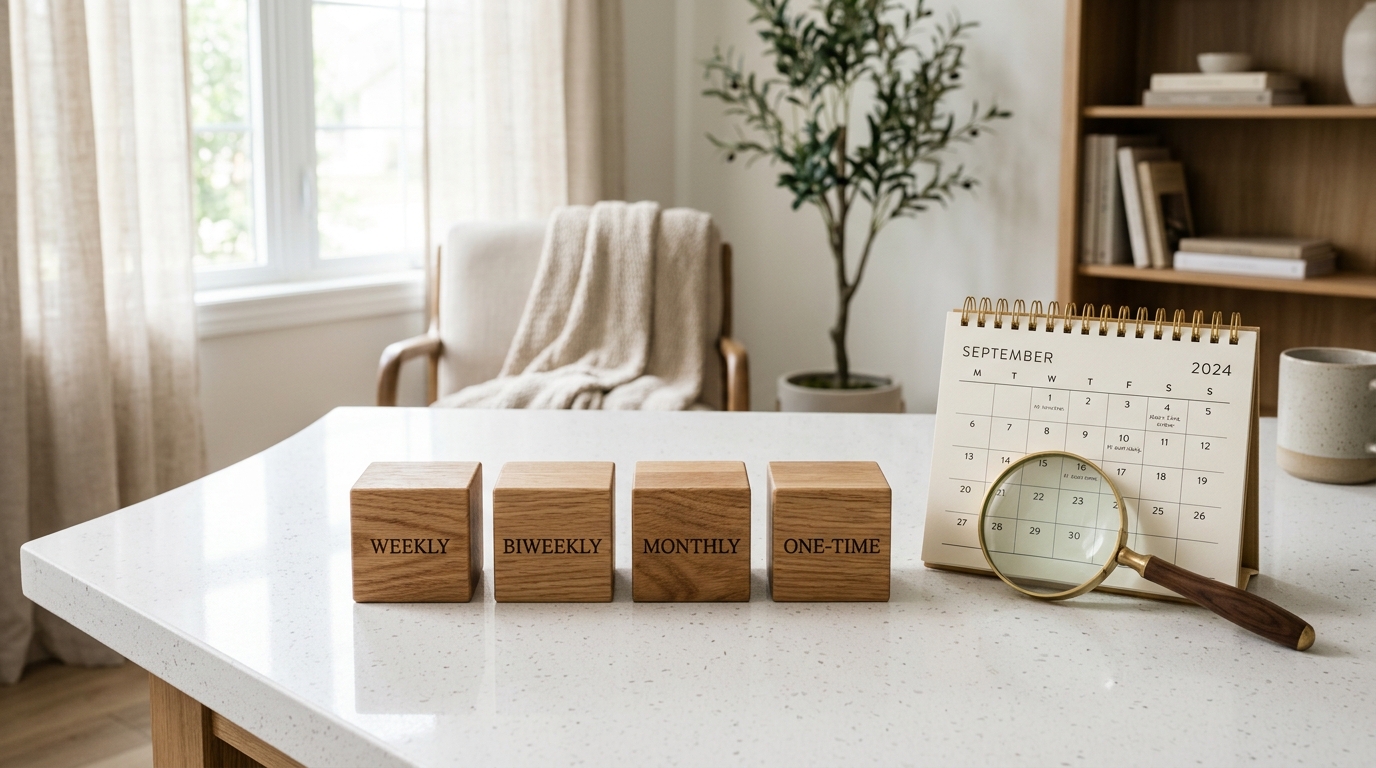
Quick Answer: Most households fall into one of four patterns: weekly for larger or higher-traffic homes, biweekly for typical households (the most common choice), monthly for smaller or lower-traffic homes, or one-time for occasional or trial needs. The right frequency depends primarily on how quickly your specific home starts to feel like it needs attention again after a cleaning.
There’s no single universally correct answer to how often you should hire a house cleaner — it depends on household size, lifestyle, budget, and simply how your specific home holds up over time. Here’s a practical framework for figuring out what actually fits your situation.
Weekly
Best for larger households, homes with young children or multiple pets, frequent entertainers, or anyone who wants a consistently guest-ready home without ever feeling more than a few days behind. This is the highest-touch, most consistent option, and it also carries the most favorable per-visit pricing of any recurring frequency, given the efficiency of a team returning to the same home every week. See our full Weekly House Cleaning page.
Biweekly
Our most commonly booked frequency, and a reasonable default if you’re not sure where to start. Frequent enough to prevent significant buildup between visits, spaced out enough to remain a cost-sustainable part of a regular routine rather than a luxury reserved for occasional use. Works well for typical family homes and dual-income households without unusually high daily traffic. See our full Biweekly House Cleaning page.
Monthly
Best for smaller households, lower-traffic homes, or homeowners who handle day-to-day tidiness themselves but want a periodic professional-grade reset for the deeper tasks that are easy to indefinitely postpone without a scheduled visit forcing the issue. See our full Monthly House Cleaning page.
One-Time
For a specific occasion, a trial run before committing to a recurring schedule, or households that genuinely only need occasional help rather than an ongoing plan. See our full One-Time House Cleaning page.
A Simple Way to Decide
Think about how quickly your home starts to feel like it needs attention again after a cleaning. If it’s within just a few days — common in larger households, homes with young kids or multiple pets, or frequent entertainers — weekly or biweekly is probably the right fit. If your home holds up reasonably well for a week or two, biweekly is a safe, popular default. If your household is smaller or lower-traffic and mostly wants periodic deeper support rather than full routine replacement, monthly likely offers better value.
You’re Not Locked In
Whatever frequency you start with, it’s not a permanent commitment — many clients begin at one frequency and adjust after a visit or two, once they have a clearer sense of how their specific home actually holds up between cleanings. Seasonal adjustments are common too: more frequent visits around the holidays when entertaining picks up, less frequent during quieter stretches.
Factors Beyond Household Size
Pets. Multiple pets tend to push households toward more frequent service, given shedding and tracked-in mess — see our Pet-Friendly House Cleaning page.
Allergies. Allergy-sensitive households sometimes choose more frequent service specifically to keep dust and allergen levels consistently lower, paired with our Allergy-Friendly House Cleaning approach.
Work-from-home schedules. Households with someone home most days generate different wear patterns than households empty most of the day — worth factoring into your frequency decision.
Entertaining habits. Frequent hosts often benefit from higher-frequency service simply to stay consistently guest-ready rather than scrambling before each gathering.
Revisiting Your Frequency Over Time
Household needs change — a growing family, a new pet, a shift to more remote work, or simply changing priorities can all justify revisiting your frequency even after you’ve settled into a routine. There’s no penalty for adjusting, and many long-term clients change frequency more than once over the life of their relationship with us.